

Overview
The Customers page lists everyone who has bought from your business. From a customer’s page you can review their payments and subscriptions, check and adjust their wallet balances, send them a Customer Portal link, and block them. The same customer records are available through the API.Customer Dashboard
Customer Wallets
Customer Portal
API Management
Accessing the Customers Page
1
Navigate to Customers
In the dashboard, go to Sales → Customers.
2
View Customer List
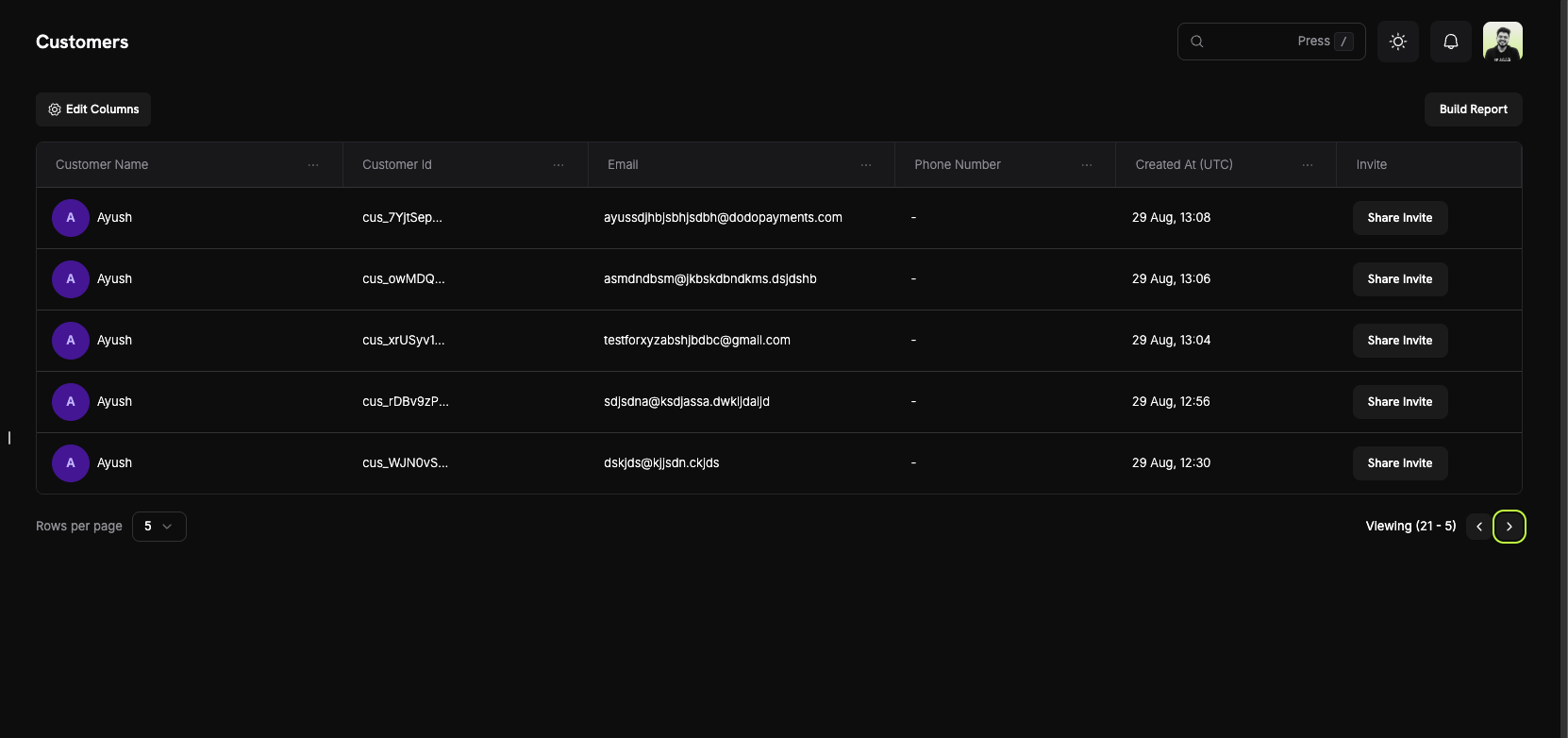
The page lists every current and past customer of your business.
Customer Information
The customer table shows one row per customer, with the columns below.Customer List Columns
- Customer Name: The customer’s full name, with an avatar.
- Customer Id: The unique identifier, starting with
cus_. Use it in API calls. - Email: The customer’s email address. The customer uses it to sign in to the Customer Portal.
- Phone Number: The customer’s phone number, if one was provided.
- Created At: When the customer record was created. Hover over the value to see the time in UTC.
- Invite: A Share Invite button that opens the Customer Portal links for this customer.
Page Features
- Column visibility: Choose which columns the table shows.
- Filters: Find customers by Name or Email Address.
- Pagination: Move through the list and set the number of Rows per page.
Customer Details Page
Click a customer to open their Customer Information page: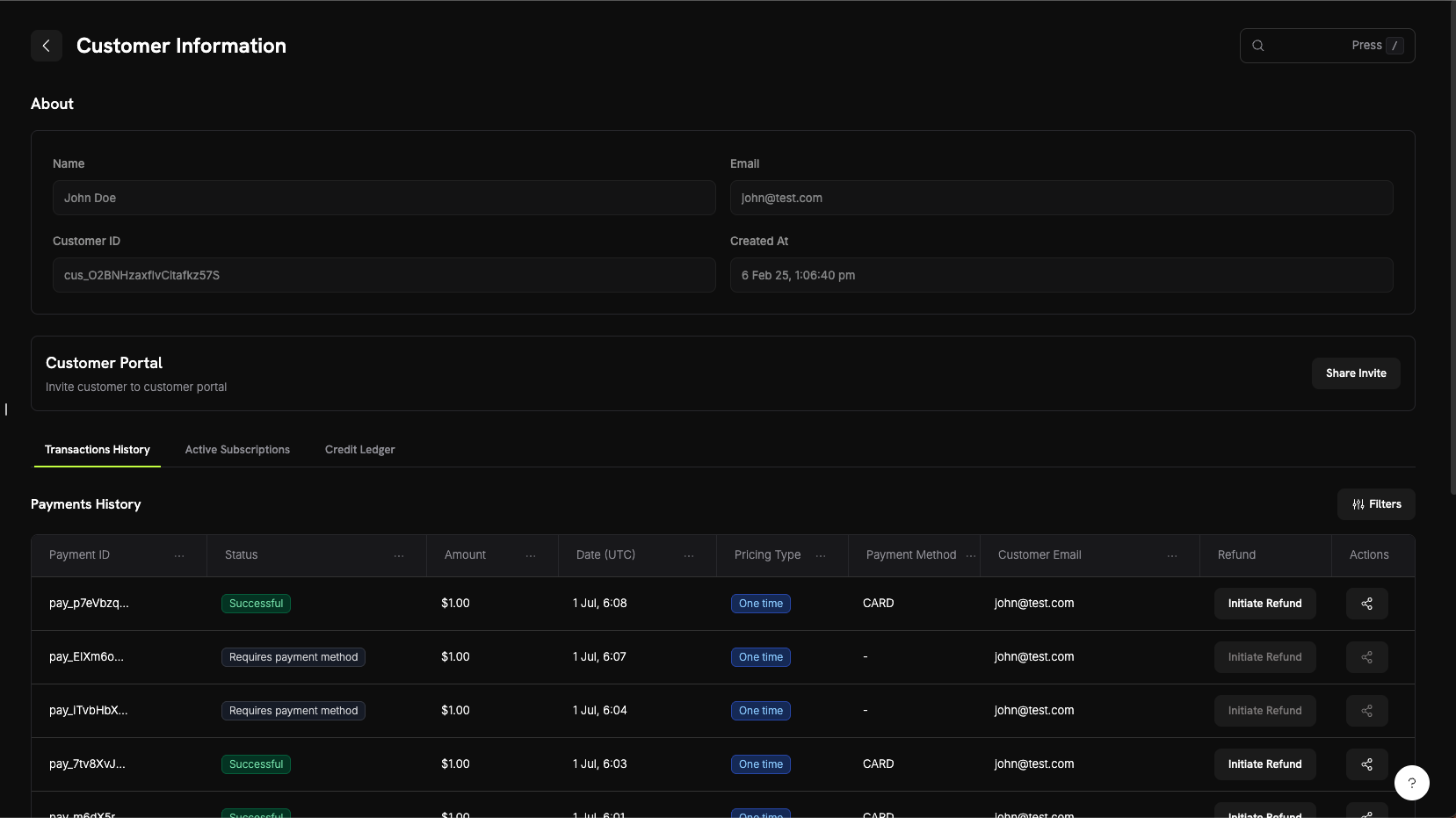
About Section
The top of the page shows the customer’s core details:- Name: The customer’s full name.
- Email: The customer’s email address.
- Customer ID: The identifier to use in the API and in support requests.
- Created At: When the customer record was created.
Customer Activity Tabs
Tabs below the details show the customer’s activity. The main ones are described here. The page also has Credits, Entitlements, and Sent Emails tabs; see Customer Email Logs for Sent Emails.- Transactions History
- Active Subscriptions
- Wallets
The customer’s payments, refunds, and disputes. The payments table shows:
- Payment ID: The payment’s identifier, starting with
pay_. - Status: The payment status, for example Successful, Failed, or Refunded.
- Amount: The payment amount.
- Date: When the payment was created.
- Pricing Type: One-time or subscription.
- Payment Method: The payment method used, such as card or UPI.
- Customer Email: The email address on the payment.
- Refund: An Initiate Refund button.
- Actions: More options for the payment.
The Wallets tab shows every change to a customer’s wallet, so you can trace how the current balance was reached.
Blocking a Customer
Block a customer who commits fraud or abuses refunds so they can’t check out with you again. Blocking cancels the customer’s live subscriptions and makes their Customer Portal read-only. A blocked customer’s page shows a Blocked badge, an Unblock Customer button, and an Activity Log of notes explaining the block. Manage all blocks from Settings → Blocklist.Customer Blocklist
Customer Portal
The Customer Portal is a hosted self-service site where your customers manage their subscriptions, view billing history, and retrieve license keys without contacting support.Portal Capabilities
In the portal, customers can:- View Billing History: See past payments and download invoices.
- Manage Subscriptions: View details, change plan, pause, or cancel, depending on your settings.
- Retrieve License Keys: See the license keys tied to their purchases.
- Update Billing Details: Change the name, billing address, and payment method on a subscription. Email address and phone number are shown but can’t be edited in the portal.
Learn More About Customer Portal
Customer Wallets
Customer Wallets hold prepaid money for a customer, one balance per currency. Dodo Payments applies a wallet balance to the customer’s subscription charges before it charges their payment method. You add or deduct funds with a ledger entry, for example to issue a refund as wallet balance or a promotional bonus.Key Features
- Multi-Currency Support: Each currency has its own balance.
- Prepaid Balances: Funds are applied to future subscription renewals and plan-change charges.
- Transaction History: The ledger records every fund addition and deduction.
- API-First Design: Check balances and add or deduct funds through the API, or from the Wallets tab.
Learn More About Customer Wallets
API Management
The Customers API lets you create, retrieve, and update customers, list them with filters, and manage their saved payment methods.Available API Endpoints
Create Customer
List Customers
Get Customer Details
Update Customer
Delete Payment Method
Create Portal Session
Email Address Rules
Dodo Payments accepts only customer email addresses that can receive mail. These rules apply when you create or update a customer, and to the new-customer details on payments and checkout sessions. An address is rejected if it:- Has no top-level domain, for example
dev@localhost. - Ends with a top-level domain that is shorter than two characters or starts with a digit.
- Uses an IP address as the domain, for example
user@[192.168.0.1]. - Contains non-ASCII characters. To use an internationalized domain, convert the domain to its ASCII form, which starts with
xn--, first. - Has a misplaced dot, for example
.user@example.com,user.@example.com, orus..er@example.com.
422 until you update the customer’s email.
Every endpoint requires your API key. Call the API from your server and never expose the key in client-side code.