

The Customer Portal is a hosted site where your customers manage their subscriptions, view and download invoices, and retrieve license keys without contacting support.
Create Portal Session (API)
Subscriptions
What Is the Customer Portal?
The portal is a self-service site, branded with your business name, where customers can:- Access billing history: View past payments and download invoices.
- Manage subscriptions: View subscription details, pause and resume, and cancel immediately or at the next billing date, as your settings allow.
- Update payment methods: Change the payment method on a subscription, or reactivate a subscription that is on hold.
- Retry failed payments: Retry a failed renewal with the saved payment method, when you turn on Payment Retries.
- Retrieve license keys: See the license keys tied to their purchases.
- Return to your app: When you pass a
return_url, the portal shows a back link to your business. On mobile, a back arrow in the header returns to the portal overview.
If you block a customer, their portal becomes read-only. They can still sign in and view invoices, subscriptions, and license keys, but they can’t cancel, pause, or resume a subscription, change plans, or update a payment method. The portal profile returns
read_only: true so a custom integration can disable its own controls.Key Benefits
- Lower support volume: Customers handle common billing requests themselves.
- Faster access: Customers get invoices and license keys as soon as they sign in.
- Lower churn risk: Customers see renewal dates and plan details before they are charged.
- Signed, expiring links: Every sign-in link is signed and expires after 24 hours.
- Localized experience: The portal is available in 21 languages and picks one from the customer’s browser settings.
Access Methods
Customers reach the portal through a static link or a dynamic link.Static Link (Email-Based Access)
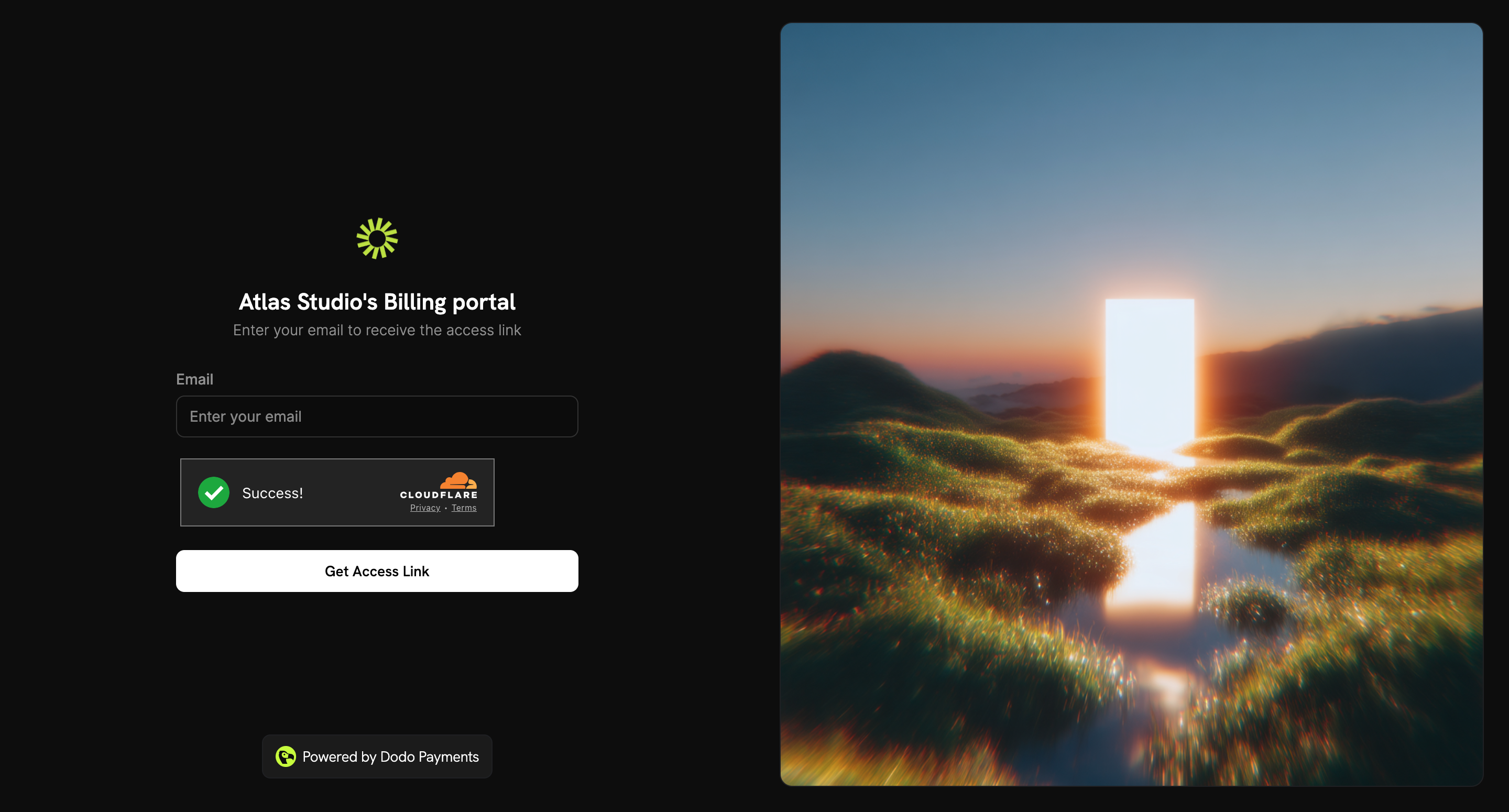
The static link never expires. A customer opens it, enters their email address, and receives a sign-in link by email. The static link depends on the environment: Test Mode (for testing and development):{business_id} with your business ID, then share the link with your customers. The Static Link in the Share Invite dialog already contains it.
1
Merchant Flow
- Go to Sales → Customers and open a customer, or use the Invite column in the list.
- Click Share Invite.
- Copy the Static Link and share it with your customer.
2
Customer Flow
- Open the static link.
- Enter the email address used at purchase and click Get Access Link.
- Open the emailed sign-in link. It is valid for 24 hours.
The page always shows the same confirmation. Dodo Payments emails a link only when the address belongs to a customer of your business, so the page doesn’t reveal who your customers are.
Sign-in emails are not sent in test mode. To open a test mode portal, use the Dynamic Link or create a session through the API.
Dynamic Link (Magic Link)
A dynamic link signs one customer straight into the portal, without an email step. It expires 24 hours after it is created.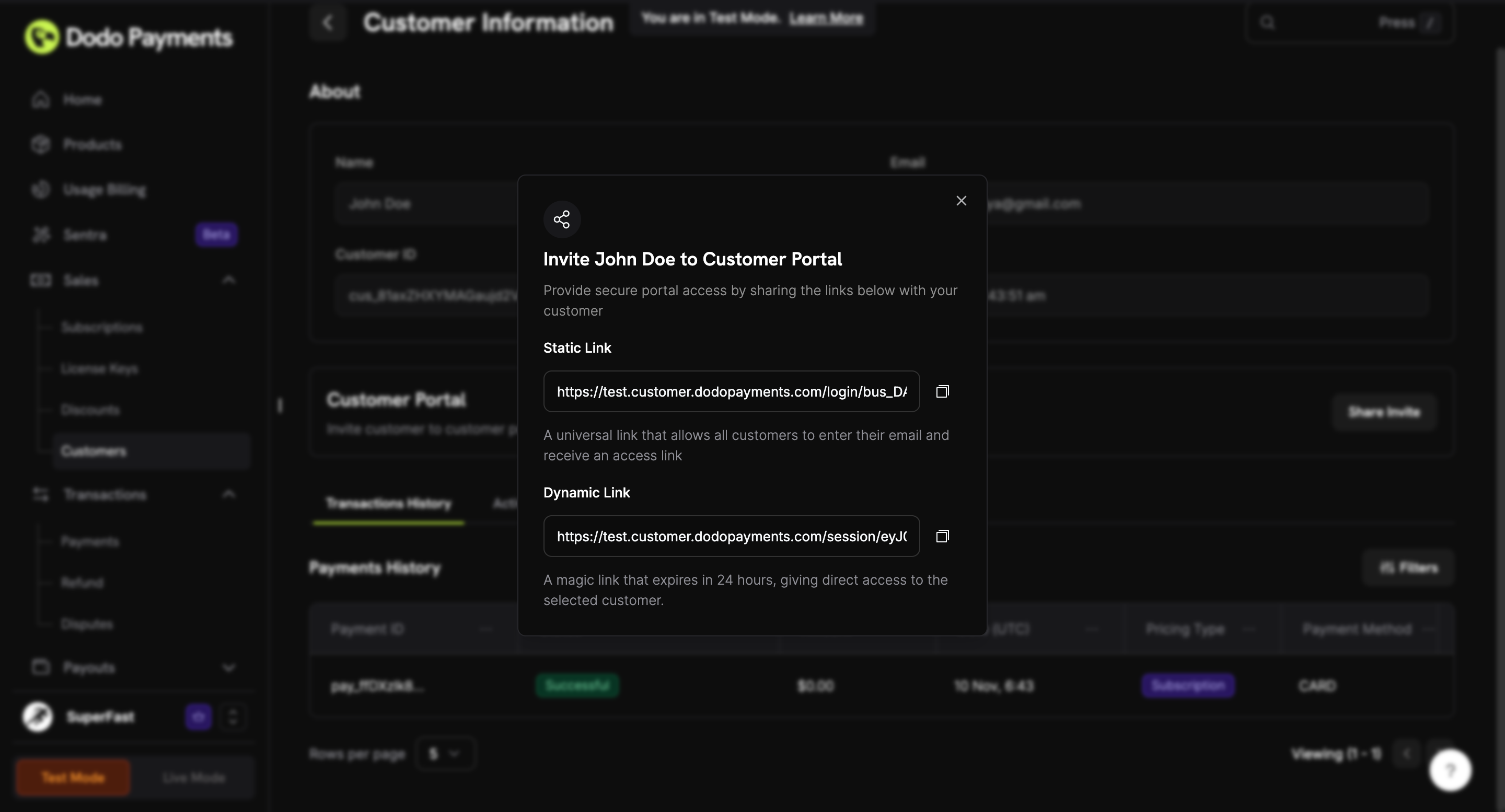
1
Merchant Flow
- Go to Sales → Customers and open the customer.
- Click Share Invite.
- Copy the Dynamic Link and share it with your customer.
2
Customer Flow
- Open the dynamic link.
- The Customer Portal opens directly, without an email address.
Portal Features
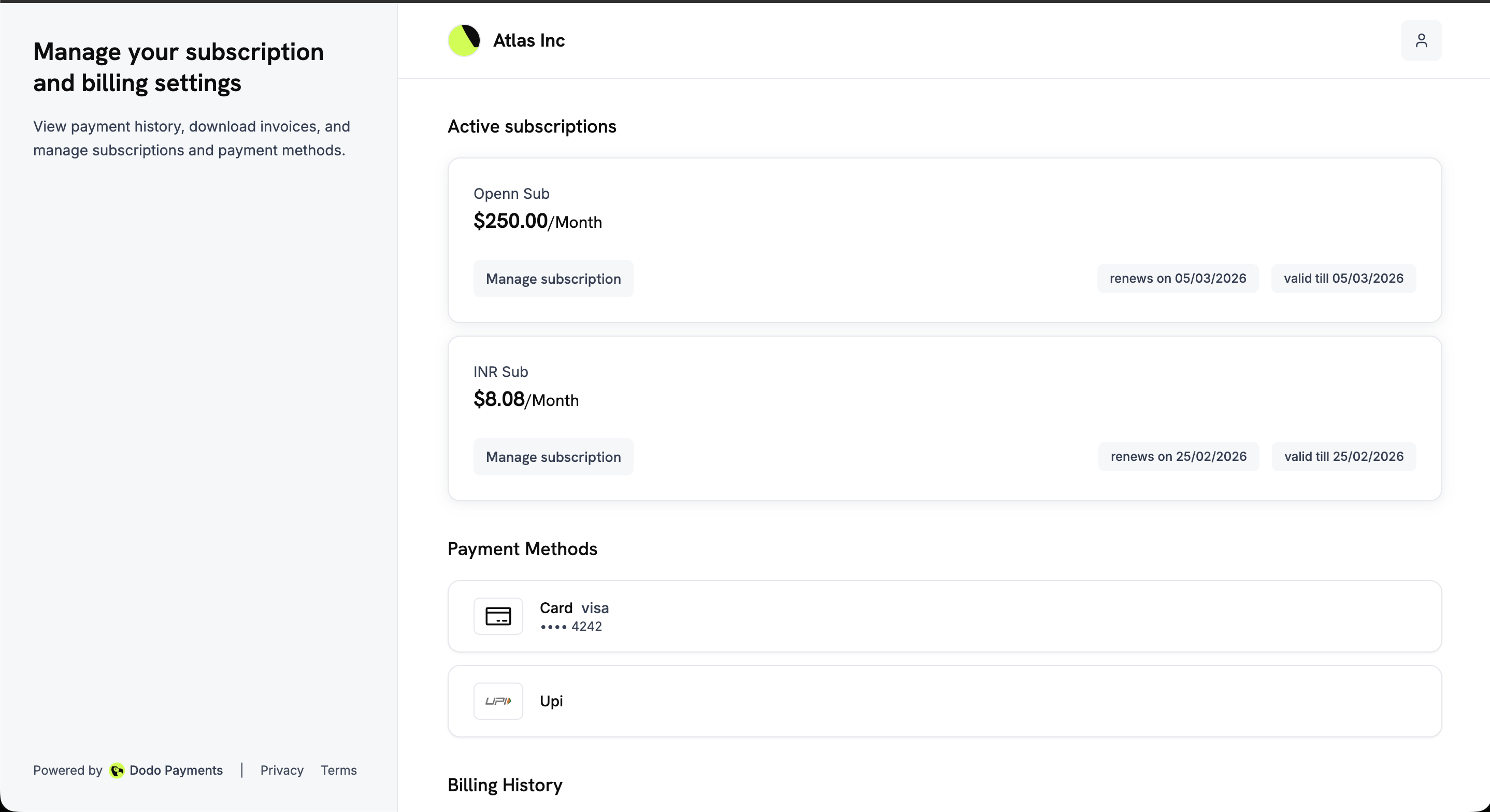
The portal overview is a single page. On desktop, a panel on the left describes the portal. The main area lists the customer’s subscriptions, payment methods, and billing history.Active Subscriptions
Payment Methods
Billing History
Billing Information
Portal Overview
The overview page shows active subscriptions, saved payment methods, and billing history in one scrollable view.Payment Methods & Billing History
Further down the page are the saved payment methods and the billing history, with a status for each payment and a download link for each invoice.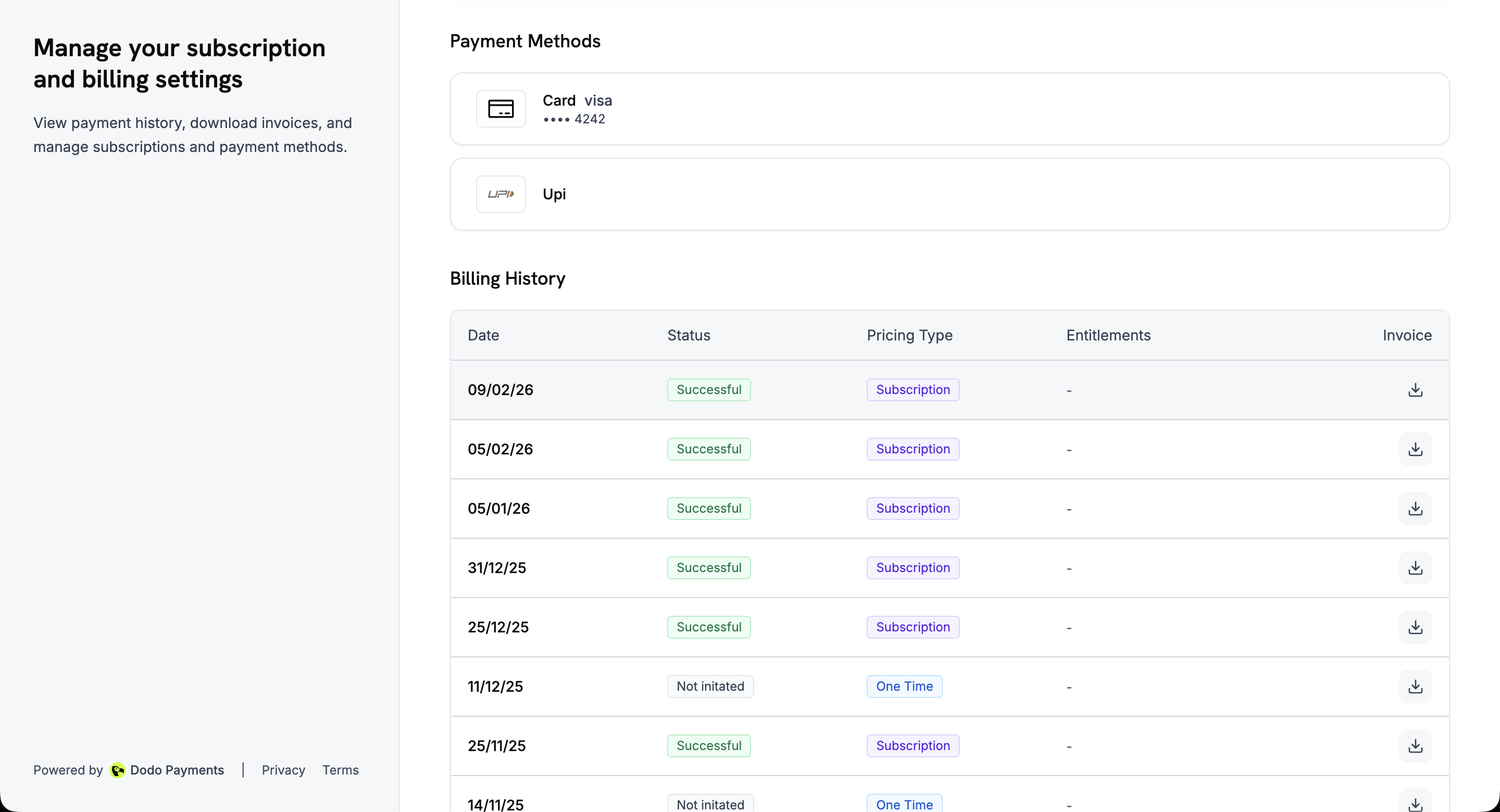
Language Support
The Customer Portal is available in 21 languages, so customers can manage subscriptions, payment methods, and billing history in their own language.How Language Selection Works
- Automatic detection: On the first visit, the portal reads the preferred language from the browser and loads it if it is supported. Otherwise it uses English.
- Manual override: Customers can change the language at any time with the language selector in the bottom-right corner of the page, on desktop and mobile.
- Persisted preference: The portal stores the choice in the
NEXT_LOCALEcookie for one year, so it remembers the language across visits.
Supported Languages
Plan Changes (Upgrade/Downgrade)
Customers can upgrade or downgrade from the portal between products in the same Product Collection.Available Actions
How Plan Changes Work
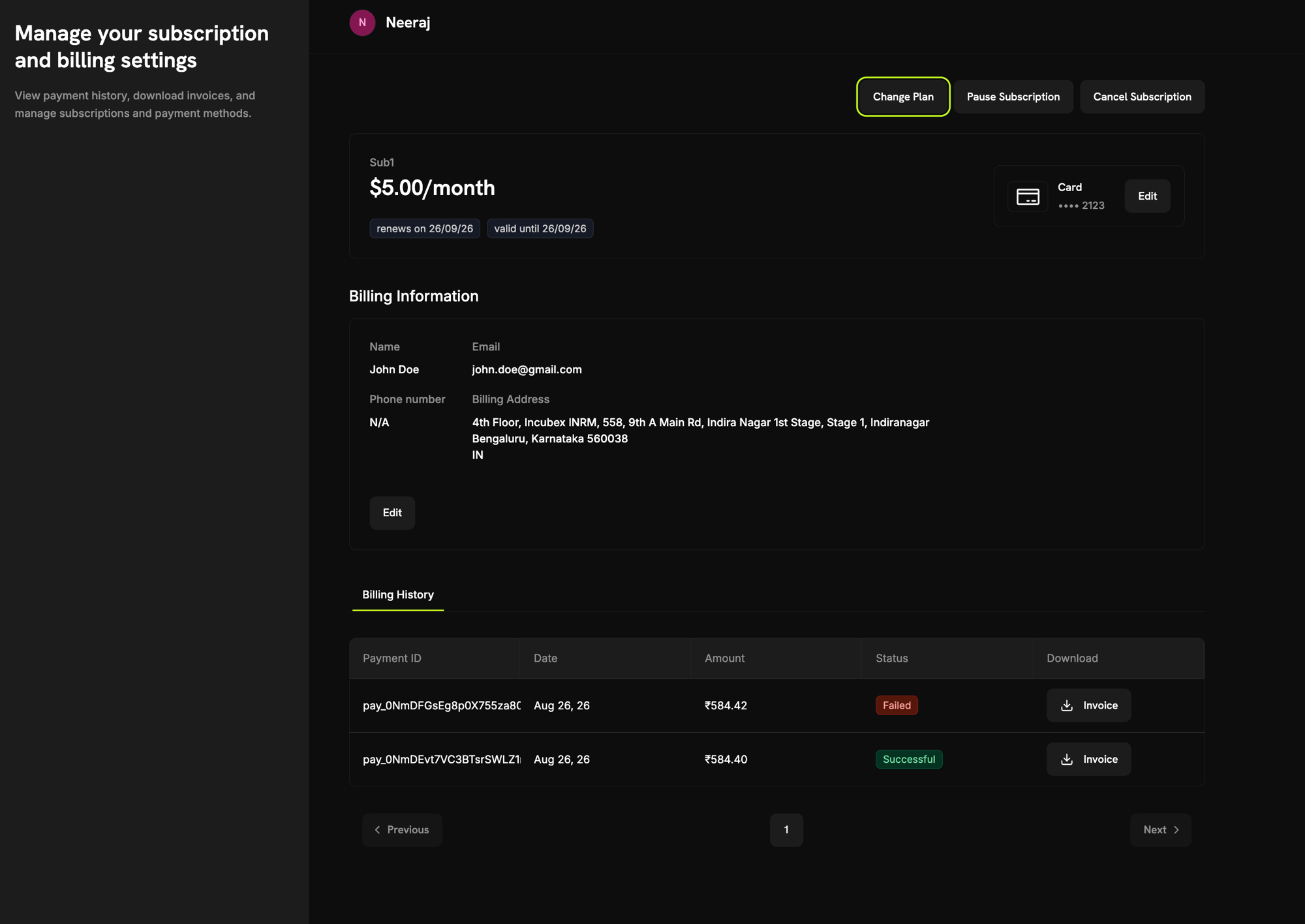
- The customer clicks Change Plan on the subscription details page.
- The portal lists the other plans in the product collection.
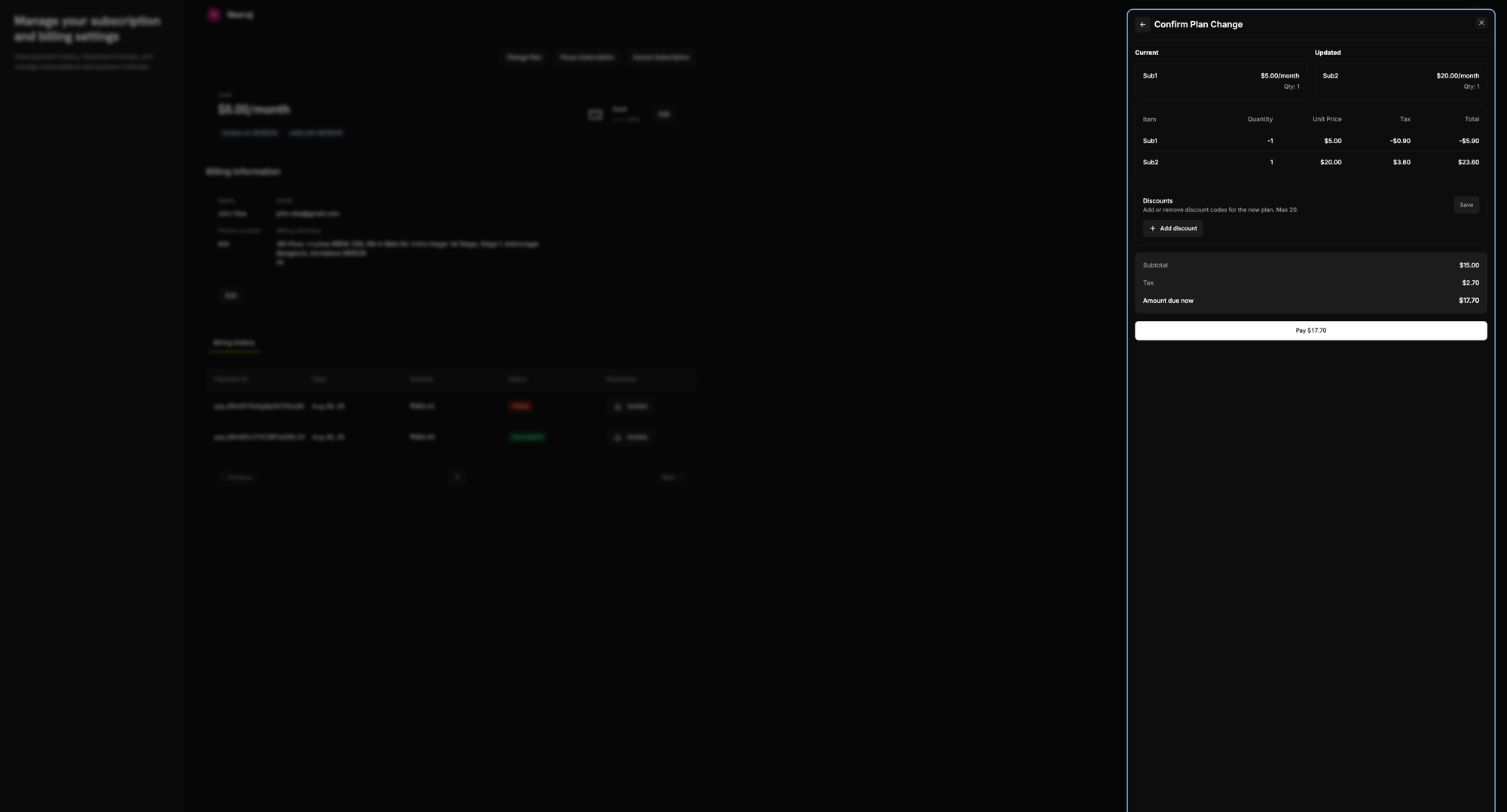
- The customer selects a plan. A Confirm Plan Change panel shows the current and updated plan, a line-item breakdown (a credit for the old plan and a charge for the new one), tax, and the amount due now. The customer can also enter a discount code here.
- The customer confirms with the Pay button, which shows the amount due.
- Dodo Payments calculates proration and collects the charge, either from the saved payment method or on a hosted checkout page if you collect plan-change payments by payment link (see Collecting Plan Change Payments by Payment Link).
- The subscription moves to the new plan. Whether this happens immediately or only after the charge succeeds depends on your payment failure handling. A plan change paid by payment link always waits for the payment.
Plan changes work only between products in the same collection, and the target product must be a subscription or usage-based product. One-time products are rejected.
Collecting Plan Change Payments by Payment Link
By default, an immediate plan change charges the customer’s saved payment method. With Collect Plan Change Payments by Payment Link turned on, the portal opens a hosted Dodo Payments checkout page in a new tab instead, and the customer pays there. This applies to upgrades and downgrades that result in a charge.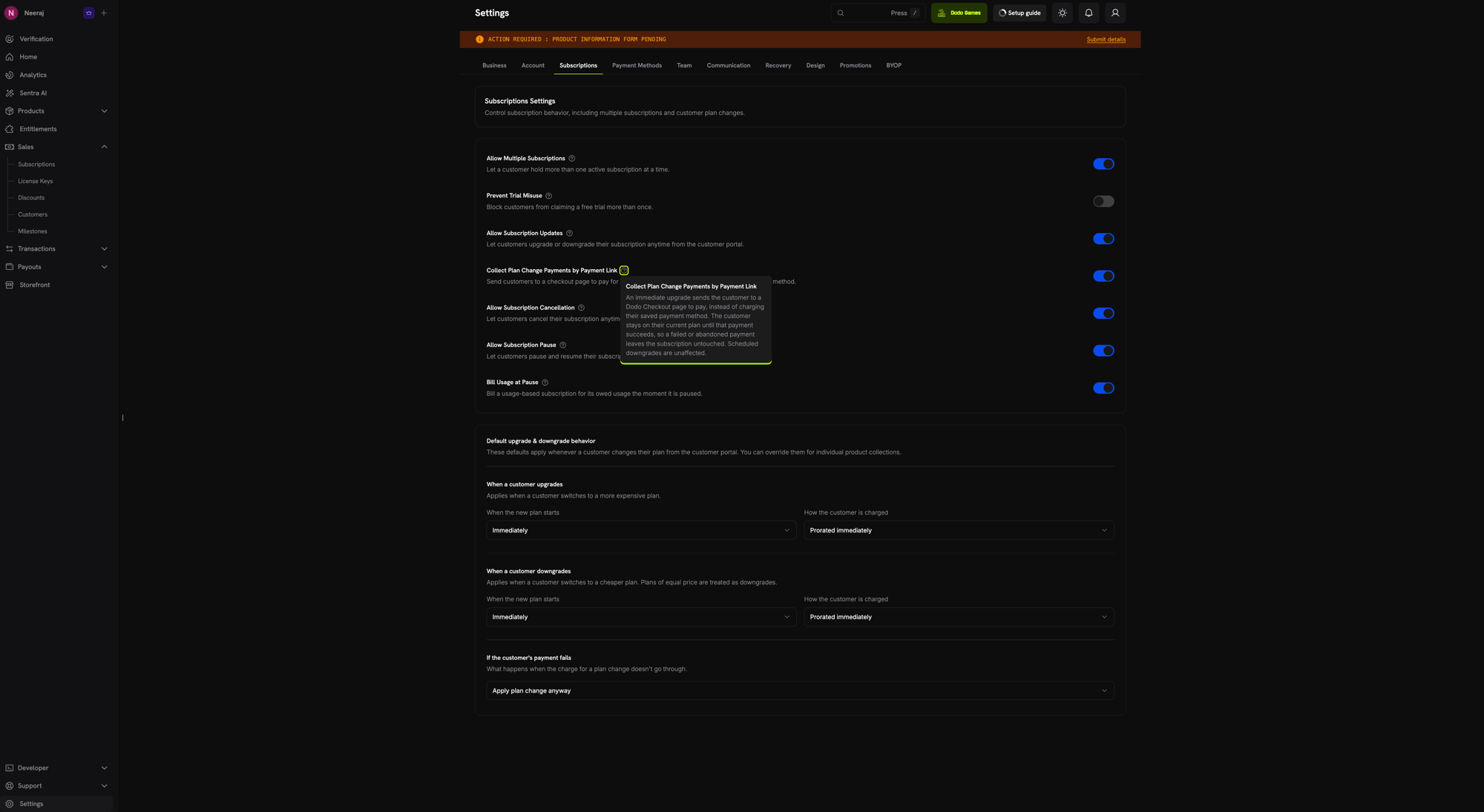
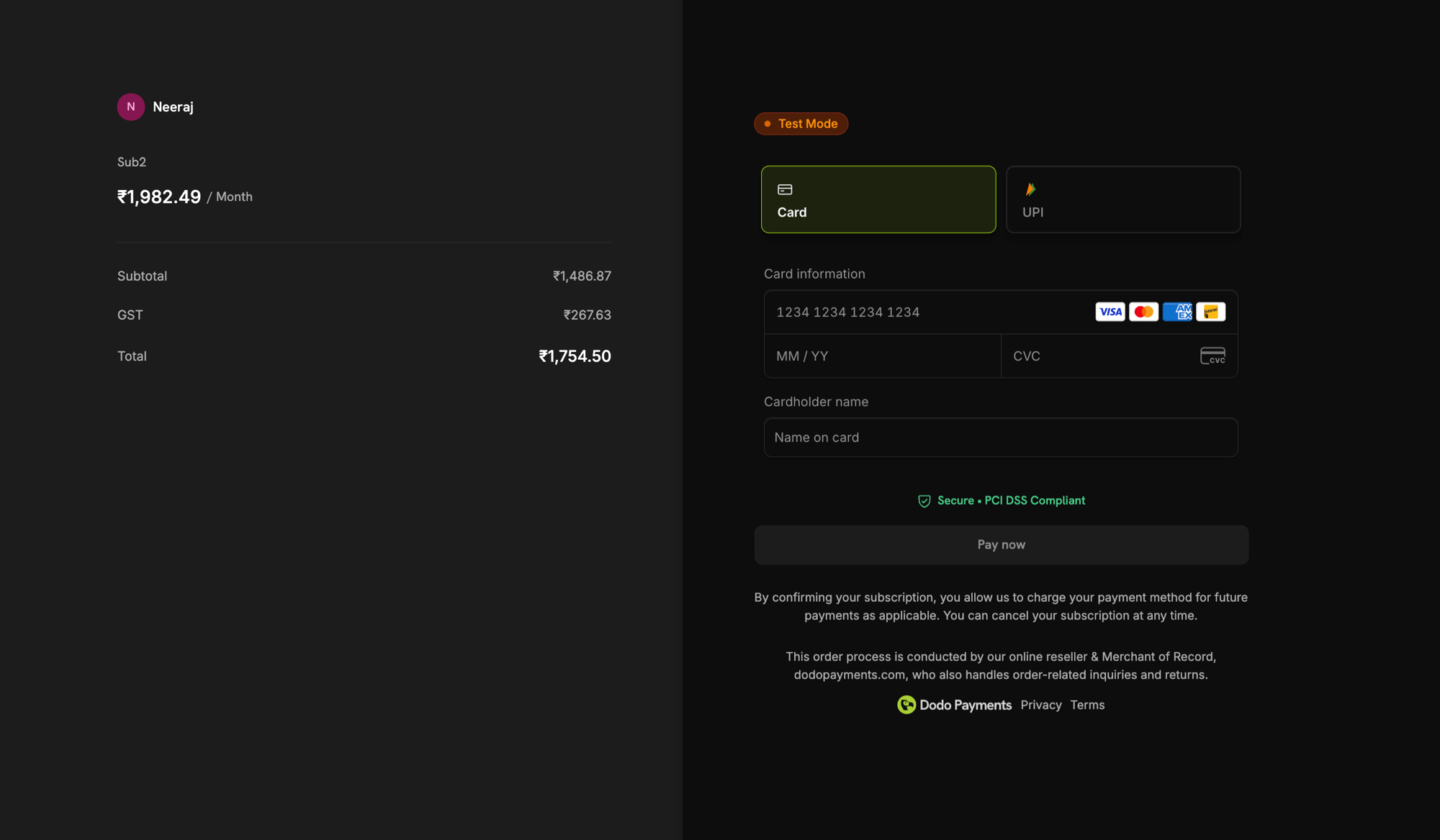
The subscription stays on its current plan until the checkout payment succeeds. A failed or abandoned payment leaves the subscription unchanged. After a declined payment, the customer starts the plan change again from the Customer Portal to get a new checkout link. Scheduled downgrades (
effective_at: next_billing_date) don’t go through checkout; they apply on the next billing date as usual.Plan Change via Payment Link (API)
Business Controls
Configure what customers can do with their subscriptions under Settings → Subscriptions:- Allow Subscription Updates: Lets customers upgrade or downgrade. Off by default.
- Allow Immediate Cancellation: Lets customers end their subscription and lose access at once. On by default.
- Allow Cancellation at Next Billing Date: Lets customers cancel at the end of the period they have paid for. On by default.
- Offer a Discount When a Customer Cancels: Offers a discount on the next billing cycle to a customer who starts to cancel. Off by default. See Retention Offer.
- Allow Subscription Pause: Lets customers pause and resume their own subscriptions. Off by default.
- Collect Plan Change Payments by Payment Link: Sends customers to a checkout page to pay for an immediate plan change, instead of charging their saved payment method. Off by default.
Product Collections
Subscription Details
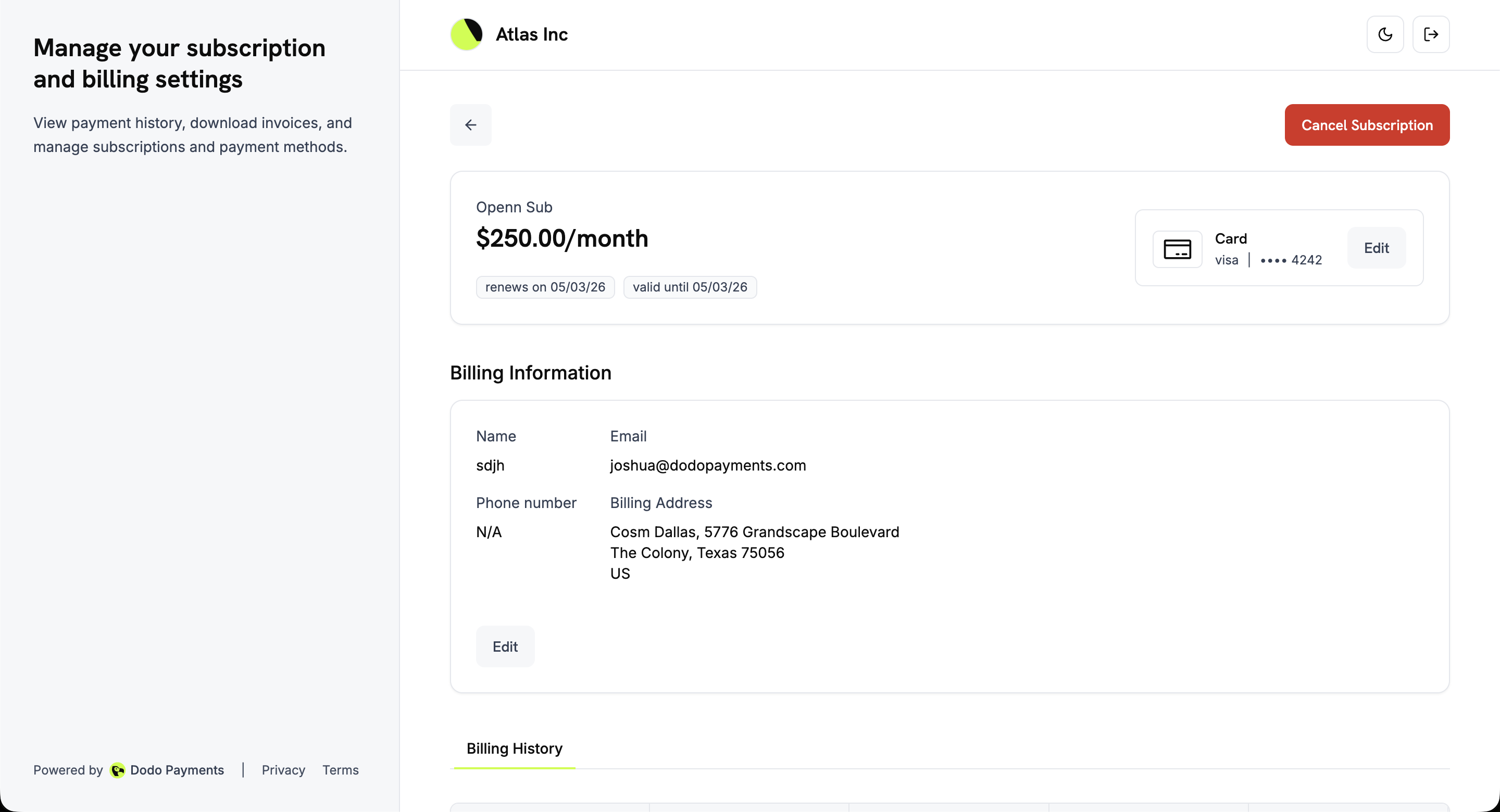
Manage subscription on any active subscription opens its details page, which shows:- Plan details: The subscription name, price, renewal date, and validity period.
- Payment method: The payment method on the subscription, with an Edit button.
- Billing information: The name, email, phone number, and billing address, with an Edit button for the name and billing address.
- Billing history: A table of all payments for this subscription.
- Pause Subscription: Shown when you allow self-service pause.
- Cancel subscription: Opens the cancellation dialog.
Cancelling a Subscription
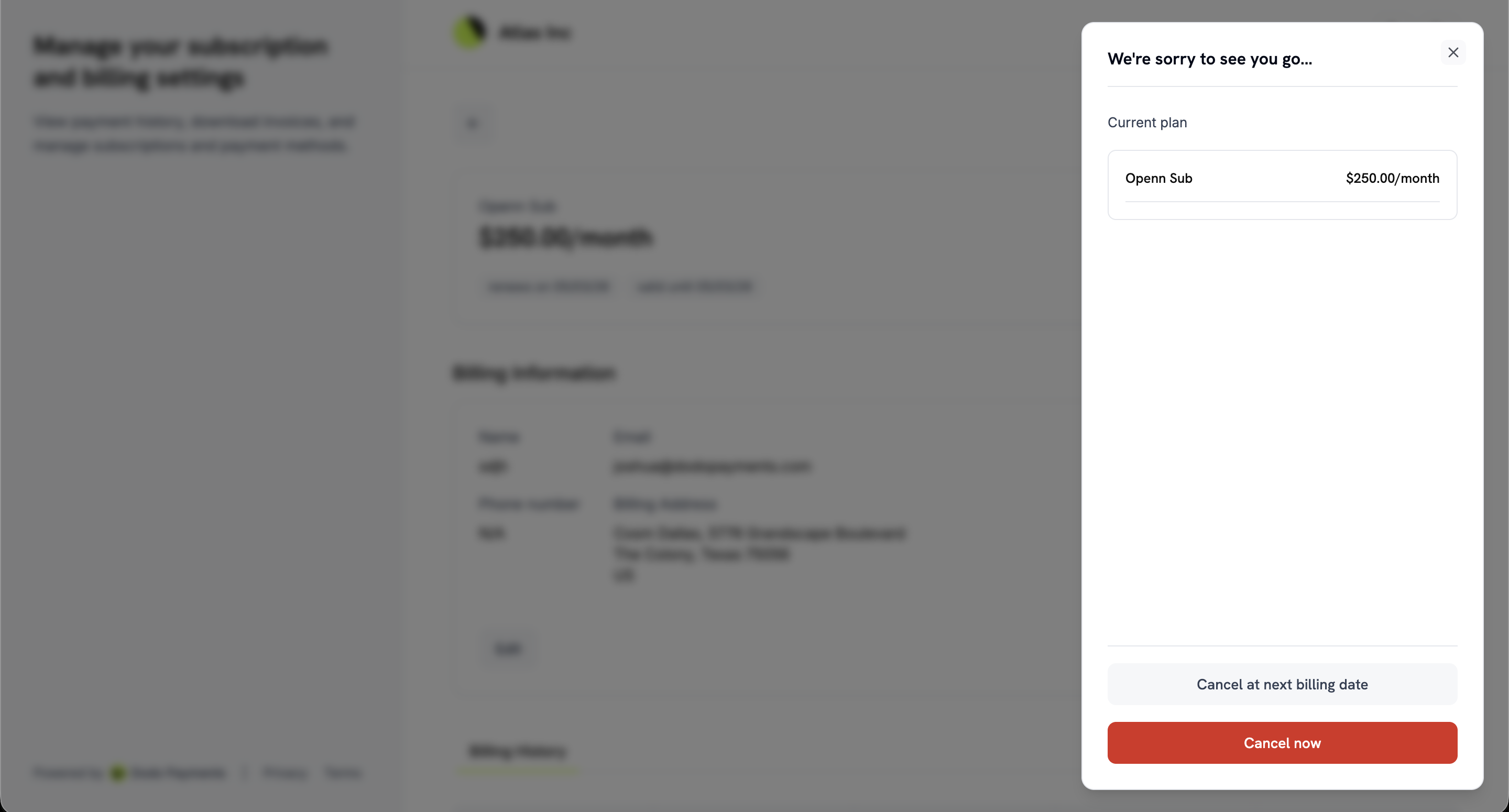
Customers cancel from the subscription details page. Cancel subscription opens a dialog with two options:- Cancel at next billing date: The subscription stays active until the current billing period ends, then cancels.
- Cancel now: The subscription is cancelled immediately.
Two settings under Settings → Subscriptions control these options separately: Allow Immediate Cancellation and Allow Cancellation at Next Billing Date. Both are on by default. Turning one off removes only that option, so you can offer one without the other. With both off, Cancel subscription is disabled, and its tooltip asks the customer to contact you. A customer with a cancellation already scheduled sees Revoke Cancellation, so they can stay, and Cancel immediately, which is the same action as Cancel now. These settings don’t affect cancellations you make yourself.
Cancellation Reasons
Before confirming, the customer must answer Why are you cancelling? by choosing a reason from a fixed list. They can also add an optional comment of up to 500 characters under Additional comments. Dodo Payments stores both on the subscription and returns them in webhook payloads and the API, so you can analyze why customers leave and tailor win-back messages.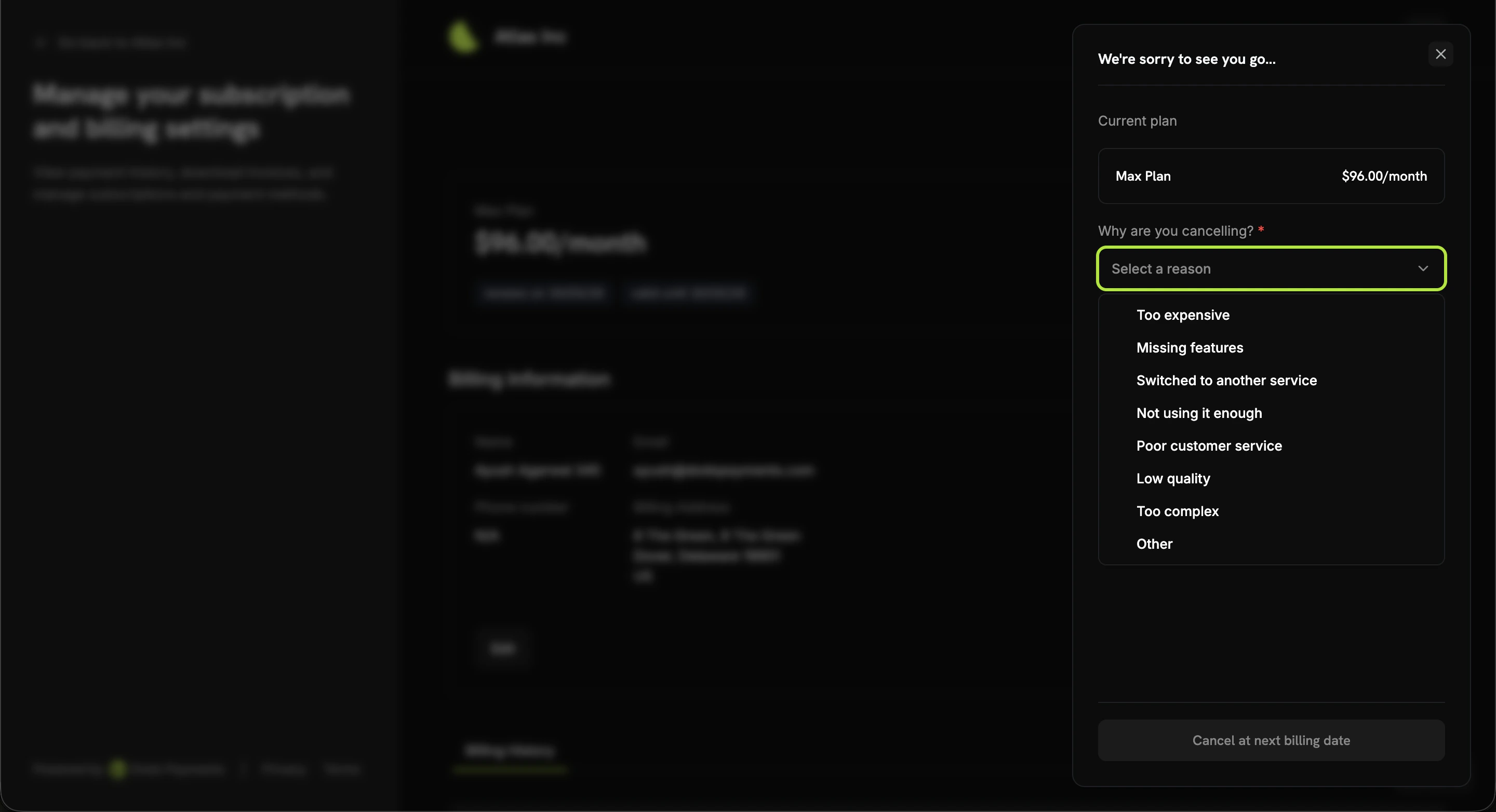
The reason is stored in the subscription’s
cancellation_feedback field, and the comment in cancellation_comment.
subscription.cancelled webhook payload. To set them yourself, pass them to PATCH /subscriptions/{subscription_id} when you cancel or schedule a cancellation through the API.
Retention Offer
The retention offer gives a customer who starts to cancel a discount on their next billing cycle, so they can keep the subscription at a lower price. Each customer can accept the offer once for your business.Turning On the Offer
To turn on the retention offer:1
Open Subscription Settings
Go to Settings → Subscriptions. The setting is in the Subscription Behavior section.
2
Turn On the Offer
Turn on Offer a Discount When a Customer Cancels. The setting is off by default.
3
Set the Discount
Enter a percentage in Discount on the next billing cycle. You can enter a value from 1 to 100, with up to 2 decimal places. The default is 10%.

What the Customer Sees
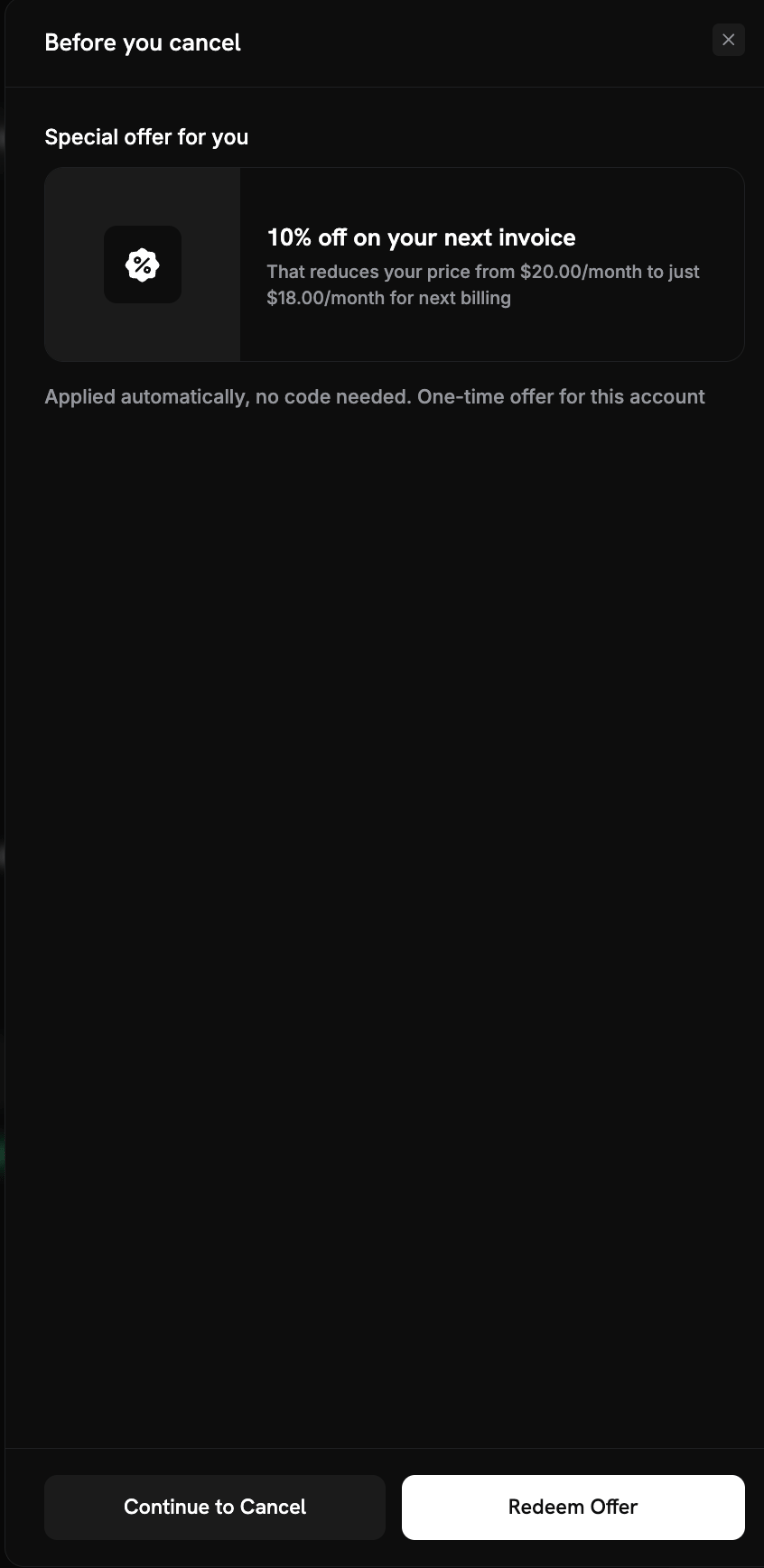
When the offer is on and the subscription qualifies, Cancel subscription opens a Before you cancel sheet. Under Special offer for you, the sheet shows the percentage off the next invoice. If the subscription has no other discount, the sheet also shows the current price and the discounted price. The customer then picks one of two buttons:- Redeem Offer: Applies the discount and keeps the subscription. The sheet changes to Offer accepted and shows the next billing date with the new amount next to the old amount.
- Continue to Cancel: Opens the cancellation options, without the discount.
Who Sees the Offer
The customer sees the offer only when all of these conditions are true:- At least one of the two cancellation settings is on, or the customer has already scheduled a cancellation.
- The subscription is
active,on_hold, orpast_due. A paused subscription doesn’t qualify. - The subscription has a recurring amount above zero, before tax.
- The subscription has no scheduled or pending plan change.
- The customer hasn’t accepted the offer before, on any of their subscriptions with your business. Turning the offer off and on again doesn’t reset this.
What Happens When the Customer Accepts
Accepting the offer discounts the next renewal and keeps the subscription.- One billing cycle: The discount applies to the next renewal only. After that renewal, the price returns to what it was before the customer accepted.
- Other discounts: If the subscription already has discount codes, the retention discount applies after them, to the already discounted price.
- Scheduled cancellation: Accepting removes a scheduled cancellation, and the subscription’s
cancelled_byis cleared. - Webhook: The subscription’s price and discounts change, so Dodo Payments sends
subscription.updated. The status of the subscription doesn’t change. - Plan changes: The retention discount doesn’t carry over to a new plan. A plan change removes it.
- Percentage changes: A new percentage applies to later acceptances only. Subscriptions that already accepted the offer keep the discount they accepted.
discount_ids while the discount applies. The discount isn’t listed with your discount codes, you can’t edit or delete it, and customers can’t enter its code at checkout.
Pausing a Subscription
Pausing gives customers an option between keeping a subscription and cancelling it. A paused subscription stops billing but keeps its plan and history, so the customer can resume it later instead of buying again. Customers open the Pause your subscription dialog from the subscription details page. The dialog shows the current plan, warns that access ends immediately, and explains how billing dates move. The customer confirms with Pause subscription.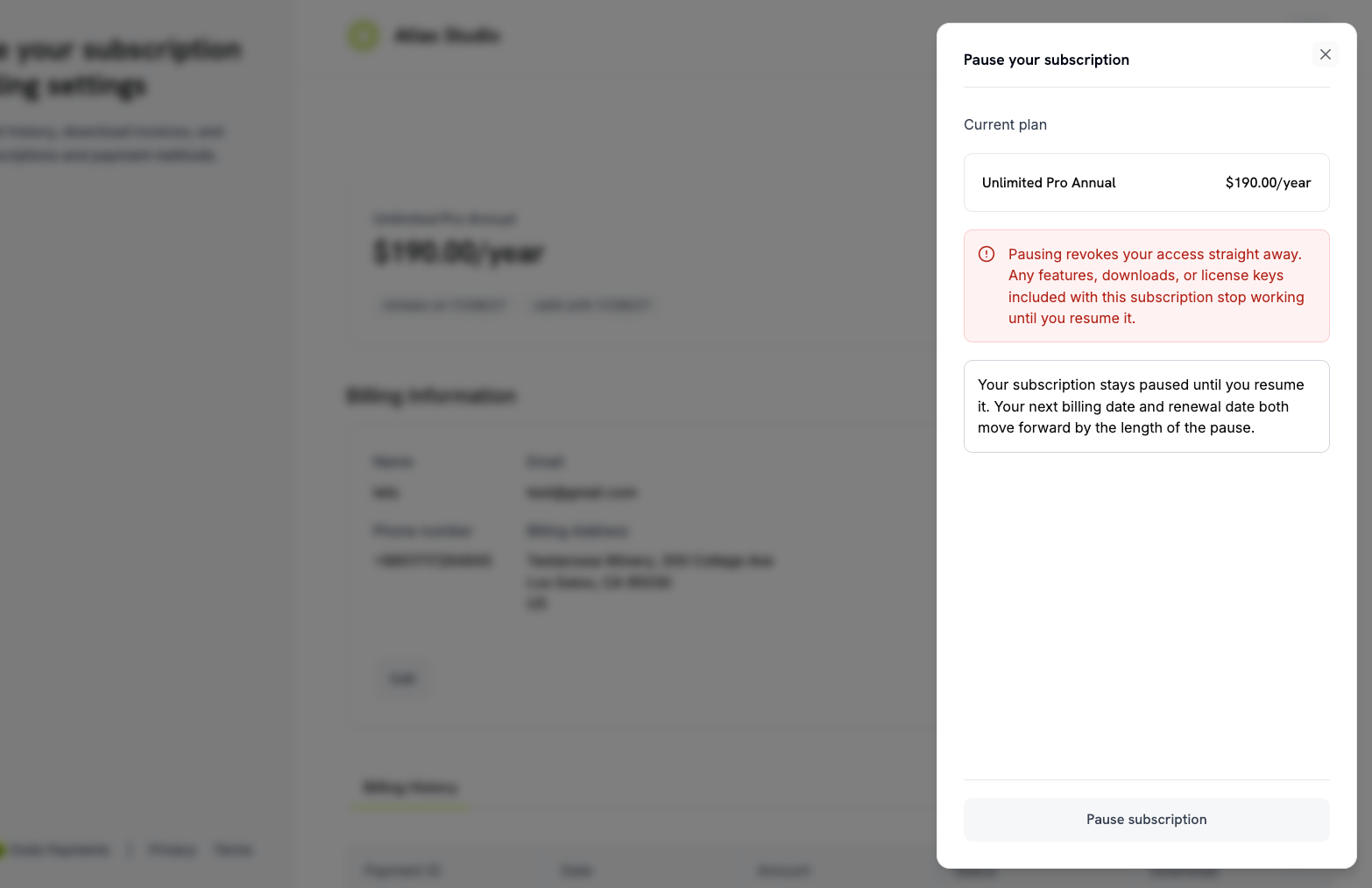
- Access stops immediately. Features, downloads, and license keys included with the subscription stop working until the subscription is resumed.
- The pause has no end date. The subscription stays paused until the customer resumes it.
- No paid time is lost. The next billing date and the renewal date both move forward by the length of the pause.
active and access is restored.
The Allow Subscription Pause setting under Settings → Subscriptions controls self-service pause, and it is off by default. While it is off, customers can’t start a new pause, but a customer can still resume a pause they started themselves. Pauses you start from the dashboard are not affected.
How Pausing Works
Updating Payment Methods
Customers change a subscription’s payment method with Edit next to the payment method on the subscription details page. This is also how a customer reactivates a subscription that is on hold after a failed payment.Reactivating Subscriptions on Hold
A subscription moves toon_hold when a payment fails. The portal shows Your subscription is currently on hold and asks the customer to update their payment method. When they do, Dodo Payments:
- Creates a charge for the remaining dues
- Generates an invoice for the charge
- Collects the payment with the new payment method
- Reactivates the subscription to
activewhen the payment succeeds
When the dues for an
on_hold subscription are paid, the subscription becomes active again.Reactivating Subscriptions in a Grace Period
If you set a grace period, a failed renewal moves the subscription topast_due instead of on_hold. The customer keeps access until the deadline.
Recovery works the same way: the customer updates the payment method, and the subscription returns to active. If they do nothing, at the deadline the subscription moves to on_hold or cancelled, as you configured, and access ends.
Retrying a Failed Payment
If you turned on Payment Retries, a subscription that ison_hold or past_due after a failed renewal shows a Retry Payment button. It charges the open renewal invoice again with the saved payment method, so a customer whose card is still valid can pay without entering new details. When the payment succeeds, the subscription returns to active.
The portal also tells the customer when the next automatic retry runs. Each renewal invoice allows 3 retries, shared with the manual retries you send from the dashboard, with a cooldown between them. When the bank declines the card for good, or the payment needs the customer to authenticate, the portal asks the customer to update their payment method instead. See Customer Retries from the Portal.
Payment Method Update Flow
1
Access Subscription Details
Click Manage subscription on the subscription from the portal overview.
2
Click Edit on Payment Method
Click Edit next to the payment method.
3
Select or Add Payment Method
Choose a saved payment method, or click Add Payment Method and enter the new details.
4
Confirm Changes
Confirm the update. For an
on_hold subscription, this creates a charge for the remaining dues.5
Complete Payment (If On Hold)
If the subscription is on hold, the customer is redirected to pay the remaining dues. When the payment succeeds, the subscription is reactivated.
6
Confirmation
The portal confirms that the payment method was updated and, for an on-hold subscription, that it is active again.
When no dues are owed, changing the card creates a zero-amount payment to verify the new card. The customer gets no payment receipt email for it, but the
payment.succeeded webhook still fires. A card update that also pays outstanding dues sends the usual receipt.Integration Examples
To send a customer from your app to the portal, create a portal session on your server and redirect the customer to the returnedlink. The link is valid for 24 hours.
send_email: true.
Unified Customer Portal
Besides your business’s portal, Dodo Payments runs a Unified Customer Portal at customer.dodopayments.com. There, customers see and manage their purchases and subscriptions from every business that sells through Dodo Payments.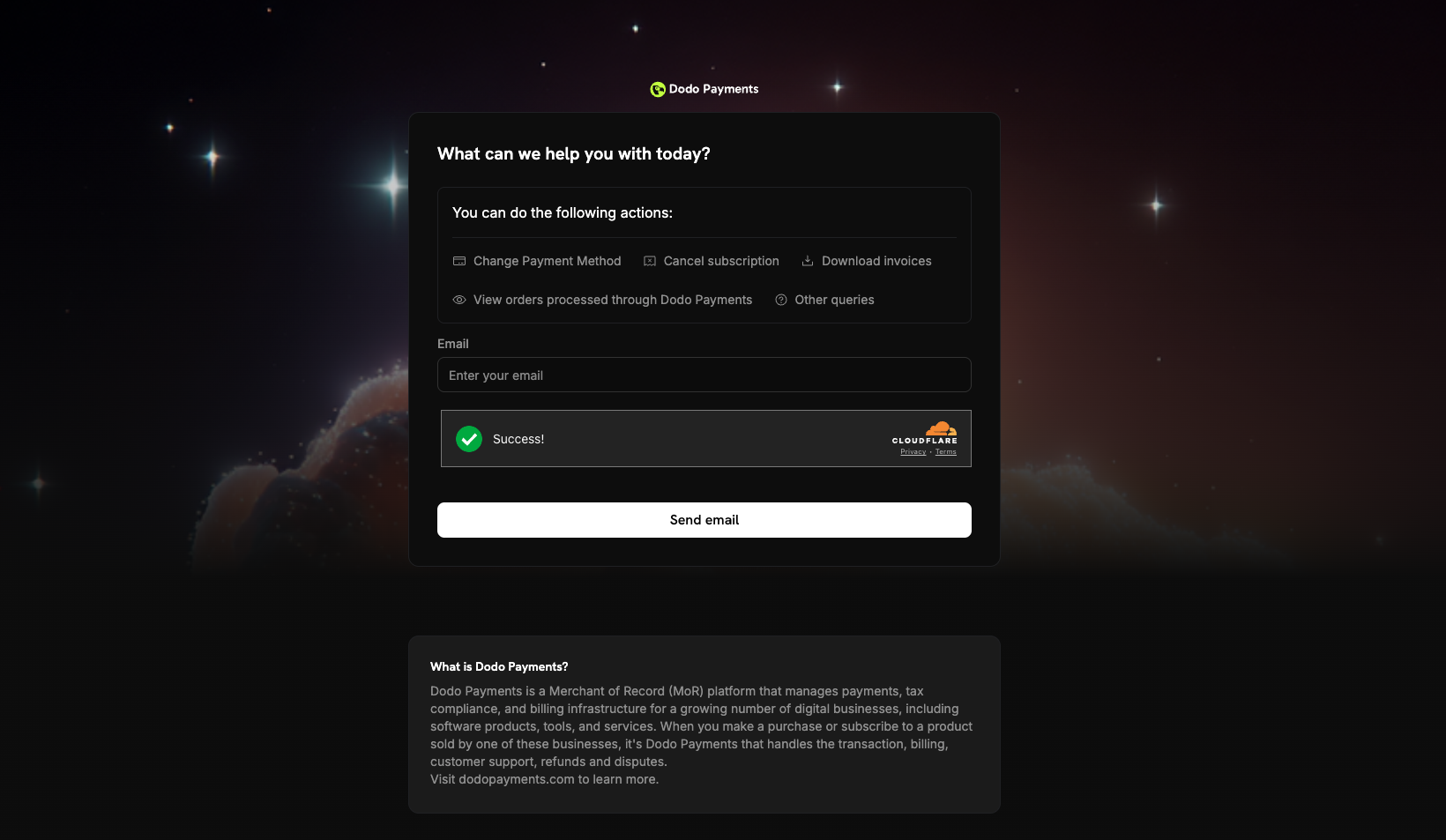
Unified Portal Features
- Cross-business visibility: See purchases and subscriptions from every Dodo Payments merchant in one place.
- Centralized management: Manage subscriptions with different businesses from one site.
- Unified billing history: Access invoices and payment history for all purchases.
- Single sign-in: Sign in once with an email address to reach purchases from all Dodo Payments merchants.
Troubleshooting
- Link expired: Generate a new dynamic link and send it to the customer.
- Email not recognized: Ask the customer to use the email address from their purchase. No sign-in email is sent for an address that isn’t a customer of your business.
- Subscription on hold: The customer updates their payment method in the portal, or clicks Retry Payment when you turn on Payment Retries. Dodo Payments charges the remaining dues and reactivates the subscription when the payment succeeds.
- Payment method update failed: If the payment fails while updating an
on_holdsubscription, the subscription stays on hold. The customer can try again with a different payment method.