> ## Documentation Index
> Fetch the complete documentation index at: https://docs.dodopayments.com/llms.txt
> Use this file to discover all available pages before exploring further.
# Inngest
> Trigger serverless functions and background jobs in Inngest based on Dodo Payments events.
## Introduction
Execute serverless functions and background jobs automatically when payment events occur. Process payments, send notifications, update databases, and run complex workflows with Inngest's reliable function execution platform.
This integration requires your Inngest webhook URL from your function configuration.
## Getting Started
In your Dodo Payments dashboard, navigate to Webhooks → + Add Endpoint and expand the integrations dropdown.
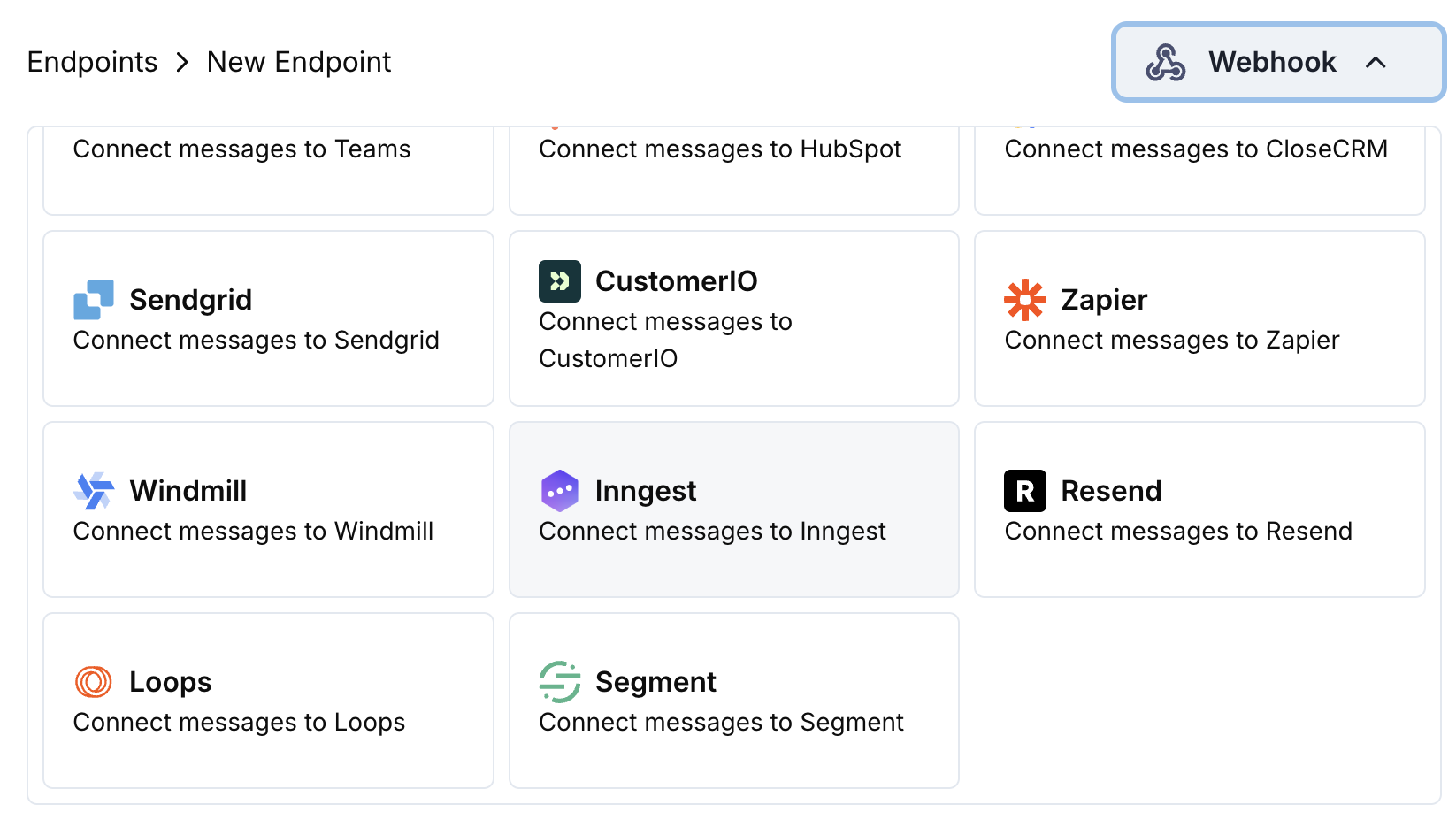 Choose the Inngest integration card.
In Inngest, create a new function and copy the webhook URL from the function configuration.
Paste the Inngest webhook URL into the endpoint configuration.
Edit the transformation code to format events for your Inngest function.
Test with sample payloads and click Create to activate the integration.
🎉 Payment events will now trigger your Inngest functions automatically.
## Transformation Code Examples
### Basic Event Payload
```javascript basic_event.js icon="js" expandable theme={null}
function handler(webhook) {
if (webhook.eventType === "payment.succeeded") {
const p = webhook.payload.data;
webhook.payload = {
name: "payment.succeeded",
data: {
payment_id: p.payment_id,
amount: (p.total_amount / 100).toFixed(2),
currency: p.currency || "USD",
customer_email: p.customer.email,
customer_name: p.customer.name,
payment_method: p.payment_method || "unknown"
},
user: {
email: p.customer.email
},
ts: Math.floor(new Date(webhook.payload.timestamp).getTime() / 1000)
};
}
return webhook;
}
```
### Subscription Event Handler
```javascript subscription_event.js icon="js" expandable theme={null}
function handler(webhook) {
const s = webhook.payload.data;
switch (webhook.eventType) {
case "subscription.active":
webhook.payload = {
name: "subscription.started",
data: {
subscription_id: s.subscription_id,
customer_email: s.customer.email,
customer_name: s.customer.name,
product_id: s.product_id,
amount: (s.recurring_pre_tax_amount / 100).toFixed(2),
frequency: s.payment_frequency_interval,
next_billing: s.next_billing_date
},
user: {
email: s.customer.email
},
ts: Math.floor(new Date(webhook.payload.timestamp).getTime() / 1000)
};
break;
case "subscription.cancelled":
webhook.payload = {
name: "subscription.cancelled",
data: {
subscription_id: s.subscription_id,
customer_email: s.customer.email,
cancelled_at: s.cancelled_at,
cancel_at_next_billing: s.cancel_at_next_billing_date
},
user: {
email: s.customer.email
},
ts: Math.floor(new Date(webhook.payload.timestamp).getTime() / 1000)
};
break;
}
return webhook;
}
```
### Dispute Event Handler
```javascript dispute_event.js icon="js" expandable theme={null}
function handler(webhook) {
if (webhook.eventType.startsWith("dispute.")) {
const d = webhook.payload.data;
webhook.payload = {
name: webhook.eventType,
data: {
dispute_id: d.dispute_id,
payment_id: d.payment_id,
amount: (d.amount / 100).toFixed(2),
status: d.dispute_status,
stage: d.dispute_stage,
remarks: d.remarks || "",
urgent: webhook.eventType === "dispute.opened"
},
user: {
email: d.customer?.email || "unknown"
},
ts: Math.floor(new Date(webhook.payload.timestamp).getTime() / 1000)
};
}
return webhook;
}
```
## Common Inngest Use Cases
* Send confirmation emails
* Update customer records
* Process refunds
* Generate invoices
* Update inventory
* Welcome new subscribers
* Process cancellations
* Send renewal reminders
* Update billing cycles
* Handle failed payments
* Update revenue metrics
* Track customer behavior
* Generate reports
* Sync data to analytics platforms
* Calculate churn rates
## Tips
* Use descriptive event names for better function organization
* Include user context for function execution
* Set proper timestamps for event ordering
* Structure data consistently across events
* Use Inngest's retry and error handling features
## Troubleshooting
* Verify webhook URL is correct and active
* Check that Inngest function is deployed and active
* Ensure event names match function triggers
* Review Inngest function logs for errors
* Check payload structure matches Inngest expectations
* Verify event names are properly formatted
* Ensure all required fields are included
* Test with Inngest's webhook testing tool
Choose the Inngest integration card.
In Inngest, create a new function and copy the webhook URL from the function configuration.
Paste the Inngest webhook URL into the endpoint configuration.
Edit the transformation code to format events for your Inngest function.
Test with sample payloads and click Create to activate the integration.
🎉 Payment events will now trigger your Inngest functions automatically.
## Transformation Code Examples
### Basic Event Payload
```javascript basic_event.js icon="js" expandable theme={null}
function handler(webhook) {
if (webhook.eventType === "payment.succeeded") {
const p = webhook.payload.data;
webhook.payload = {
name: "payment.succeeded",
data: {
payment_id: p.payment_id,
amount: (p.total_amount / 100).toFixed(2),
currency: p.currency || "USD",
customer_email: p.customer.email,
customer_name: p.customer.name,
payment_method: p.payment_method || "unknown"
},
user: {
email: p.customer.email
},
ts: Math.floor(new Date(webhook.payload.timestamp).getTime() / 1000)
};
}
return webhook;
}
```
### Subscription Event Handler
```javascript subscription_event.js icon="js" expandable theme={null}
function handler(webhook) {
const s = webhook.payload.data;
switch (webhook.eventType) {
case "subscription.active":
webhook.payload = {
name: "subscription.started",
data: {
subscription_id: s.subscription_id,
customer_email: s.customer.email,
customer_name: s.customer.name,
product_id: s.product_id,
amount: (s.recurring_pre_tax_amount / 100).toFixed(2),
frequency: s.payment_frequency_interval,
next_billing: s.next_billing_date
},
user: {
email: s.customer.email
},
ts: Math.floor(new Date(webhook.payload.timestamp).getTime() / 1000)
};
break;
case "subscription.cancelled":
webhook.payload = {
name: "subscription.cancelled",
data: {
subscription_id: s.subscription_id,
customer_email: s.customer.email,
cancelled_at: s.cancelled_at,
cancel_at_next_billing: s.cancel_at_next_billing_date
},
user: {
email: s.customer.email
},
ts: Math.floor(new Date(webhook.payload.timestamp).getTime() / 1000)
};
break;
}
return webhook;
}
```
### Dispute Event Handler
```javascript dispute_event.js icon="js" expandable theme={null}
function handler(webhook) {
if (webhook.eventType.startsWith("dispute.")) {
const d = webhook.payload.data;
webhook.payload = {
name: webhook.eventType,
data: {
dispute_id: d.dispute_id,
payment_id: d.payment_id,
amount: (d.amount / 100).toFixed(2),
status: d.dispute_status,
stage: d.dispute_stage,
remarks: d.remarks || "",
urgent: webhook.eventType === "dispute.opened"
},
user: {
email: d.customer?.email || "unknown"
},
ts: Math.floor(new Date(webhook.payload.timestamp).getTime() / 1000)
};
}
return webhook;
}
```
## Common Inngest Use Cases
* Send confirmation emails
* Update customer records
* Process refunds
* Generate invoices
* Update inventory
* Welcome new subscribers
* Process cancellations
* Send renewal reminders
* Update billing cycles
* Handle failed payments
* Update revenue metrics
* Track customer behavior
* Generate reports
* Sync data to analytics platforms
* Calculate churn rates
## Tips
* Use descriptive event names for better function organization
* Include user context for function execution
* Set proper timestamps for event ordering
* Structure data consistently across events
* Use Inngest's retry and error handling features
## Troubleshooting
* Verify webhook URL is correct and active
* Check that Inngest function is deployed and active
* Ensure event names match function triggers
* Review Inngest function logs for errors
* Check payload structure matches Inngest expectations
* Verify event names are properly formatted
* Ensure all required fields are included
* Test with Inngest's webhook testing tool